Jul 1, 2026·Web Development
What Is Web Development? Everything You Need to Know
 Anushri Golwalkar
Artificial Intelligence is no longer a future investment—it's becoming part of everyday business operations.
Across manufacturing, healthcare, logistics, finance, education, and professional services, organizations are investing in AI agents to automate repetitive work, improve decision-making, and increase operational efficiency.
Yet there's a growing disconnect.
Many organizations successfully build AI prototypes, but only a small percentage transform them into production systems that employees rely on every day.
The challenge isn't that AI isn't capable.
The challenge is turning a promising AI demo into a reliable business system.
---
An AI agent can answer questions, summarize documents, or generate insights. But real business value begins when AI can interact with your existing systems.
For example, an AI sales assistant should do more than recommend a qualified lead—it should create the lead in your CRM, notify the sales team, update reports, and trigger the next step automatically.
Without these integrations, AI becomes another isolated tool instead of a productive member of your business workflow.
The difference between an AI demo and production AI isn't the model—it's integration.
---
Many companies begin with a broad objective like:
*"Let's implement AI."*
Successful projects begin with one clearly defined workflow instead.
Examples include:
A focused problem produces measurable business results.
---
An AI agent must work with the software your business already depends on.
Whether it's your CRM, ERP, HRMS, inventory platform, or internal dashboards, AI should fit naturally into existing operations rather than creating additional manual work.
Production-ready AI is built around workflows—not standalone conversations.
---
Enterprise AI requires trust.
That means every production deployment should include:
These features may not be exciting, but they're what transform an AI pilot into a reliable business system.
---
Organizations that successfully deploy enterprise AI typically follow the same approach:
Rather than trying to automate everything at once, successful organizations solve one valuable problem exceptionally well before scaling further.
Businesses don't succeed with AI because they deploy more models—they succeed because they build better workflows.
---
The purpose of AI isn't to replace employees.
It's to eliminate repetitive work so people can focus on decision-making, creativity, customer relationships, and business growth.
When AI is integrated correctly, businesses benefit from:
Technology creates value when it becomes part of everyday operations—not when it remains an isolated experiment.
---
An enterprise AI agent is an intelligent software system that performs business tasks by interacting with existing applications such as CRM, ERP, HR, finance, inventory, and customer support platforms.
---
Most AI initiatives struggle because they lack clear business objectives, proper system integration, or the governance required for production deployment.
---
Repetitive, rule-based workflows such as:
typically deliver the fastest return on investment.
---
Start with one measurable workflow, integrate AI into existing business systems, monitor performance, and expand gradually once measurable value has been demonstrated.
---
Enterprise AI isn't defined by how many models you deploy—it's defined by how effectively AI becomes part of your daily operations.
The organizations seeing the greatest results aren't necessarily using more AI.
They're using AI more intelligently.
At Workbitz AI, our team works closely with businesses to identify automation opportunities, design practical AI workflows, and build production-ready solutions that integrate seamlessly with existing software.
The companies that gain the greatest advantage from AI won't be the ones using the most tools—they'll be the ones building the smartest workflows.
---
Whether you're exploring AI automation, enterprise workflow integration, or custom software development, success begins with identifying the right business process—not simply choosing the latest AI model.
At Workbitz AI, we help organizations build production-ready AI systems that integrate with existing operations and deliver measurable business outcomes.
Let's build AI that works in production—not just in presentations.
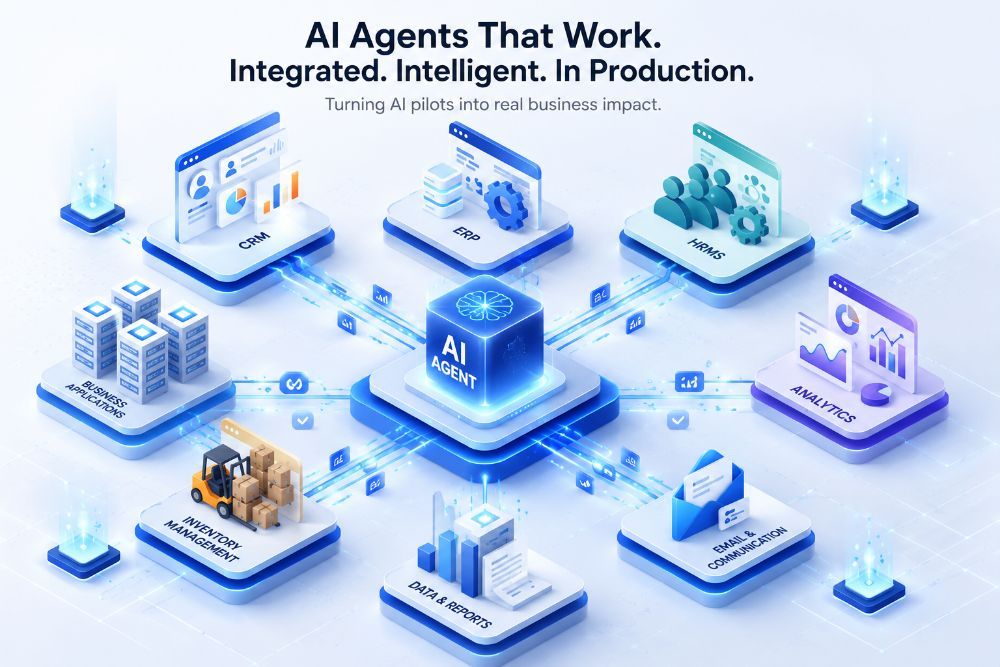
AI agent integrating CRM, ERP, HRMS, analytics, email, and enterprise applications through intelligent workflow automation.